

The MSP Marketing Stack You Need (And What to Eliminate)2026

The Hidden Cost of Marketing Tool Chaos

Last month, I spoke with Jake, an MSP owner from Denver who was spending $1,847 per month on marketing tools. When we listed them out, he had:
- HubSpot CRM ($450/month)
- Mailchimp for email ($89/month)
- Hootsuite for social media ($99/month)
- Google Ads management tool ($199/month)
- Lead tracking software ($297/month)
- Landing page builder ($47/month)
- Analytics platform ($129/month)
- Appointment scheduling tool ($39/month)
- Plus several smaller subscriptions
The real kicker? None of these tools was talking to each other. Jake was manually copying lead information between systems, his email campaigns weren’t synced with his CRM, and he had no clear picture of which marketing efforts were actually generating qualified appointments.
This is exactly the problem with The MSP Marketing Stack You Actually Need (And What to Eliminate). Most MSPs think they need more tools when they actually need fewer, better-integrated ones.
Why Generic Marketing Tools Fail MSPs
Here’s what most MSP owners don’t realize: generic marketing platforms weren’t built for your business model. They don’t understand that your sales cycle is longer, your average deal size is higher, and your prospects need to trust you with their entire IT infrastructure.
When you’re using tools designed for e-commerce or SaaS companies, you end up with:
- Lead scoring that doesn’t match MSP buyer behavior
- Email templates that sound like every other vendor
- Campaign tracking that misses your longer sales cycles
- Integration headaches that waste hours every week
The result? You’re working harder, not smarter, and still struggling with unpredictable lead flow.
What Your Marketing Stack Actually Needs to Do
Before we talk about specific tools, let’s get clear on what your marketing system needs to accomplish:
1. Generate Qualified Leads Consistently
Not just any leads – prospects who actually need MSP services, have a budget, and are ready to move away from their current solution (or lack thereof).
2. Nurture Prospects Through Your Sales Cycle
MSP sales cycles are typically 30-90 days. Your marketing stack needs to keep prospects engaged throughout this entire journey.
3. Book Qualified Appointments
The goal isn’t just lead generation – it’s getting decision-makers on the phone with your sales team.
4. Track ROI Accurately
You need to know which campaigns, channels, and messages are actually driving revenue, not just vanity metrics.
5. Save You Time
Your marketing should run in the background while you focus on serving clients and growing your business.
The Essential Components of The MSP Marketing Stack You Actually Need
After working with hundreds of MSPs, here are the core components that actually matter:
Component 1: Integrated CRM + Marketing Automation
This is your foundation. Instead of separate CRM and email platforms, you need a system that combines both with MSP-specific features.
What to look for:
- Built-in email marketing with MSP templates
- Lead scoring based on MSP buyer signals
- Automated follow-up sequences for different prospect types
- Integration with your PSA/RMM tools
What to eliminate:
- Standalone email platforms (Mailchimp, Constant Contact)
- Generic CRMs that require heavy customization
- Separate marketing automation tools
Component 2: Content Management + Lead Capture
You need a way to create and manage MSP-specific content that actually converts prospects into leads.
What to look for:
- Pre-built MSP content libraries
- Landing page templates designed for IT services
- Lead magnets that resonate with business owners
- SEO optimization for MSP keywords
What to eliminate:
- Generic landing page builders
- DIY content creation (unless you have dedicated marketing staff)
- One-size-fits-all lead magnets
Component 3: Multi-Channel Campaign Management
Your prospects are on LinkedIn, Google, email, and other channels. You need a system that manages campaigns across all these touchpoints.
What to look for:
- LinkedIn outreach automation
- Google Ads management with MSP-specific targeting
- Email sequences that integrate with other channels
- Social media posting with MSP-focused content
What to eliminate:
- Separate tools for each channel
- Generic social media schedulers
- DIY Google Ads management (unless you’re an expert)
Component 4: Appointment Scheduling + Pipeline Management
The end goal is getting prospects on the phone. Your stack needs to make this seamless.
What to look for:
- Integrated scheduling that syncs with your calendar
- Automated appointment confirmations and reminders
- Pipeline tracking from lead to closed deal
- Reporting that shows true ROI
What to eliminate:
- Standalone scheduling tools
- Manual appointment confirmation processes
- Disconnected pipeline tracking
The Tools Most MSPs Should Eliminate (And Why)
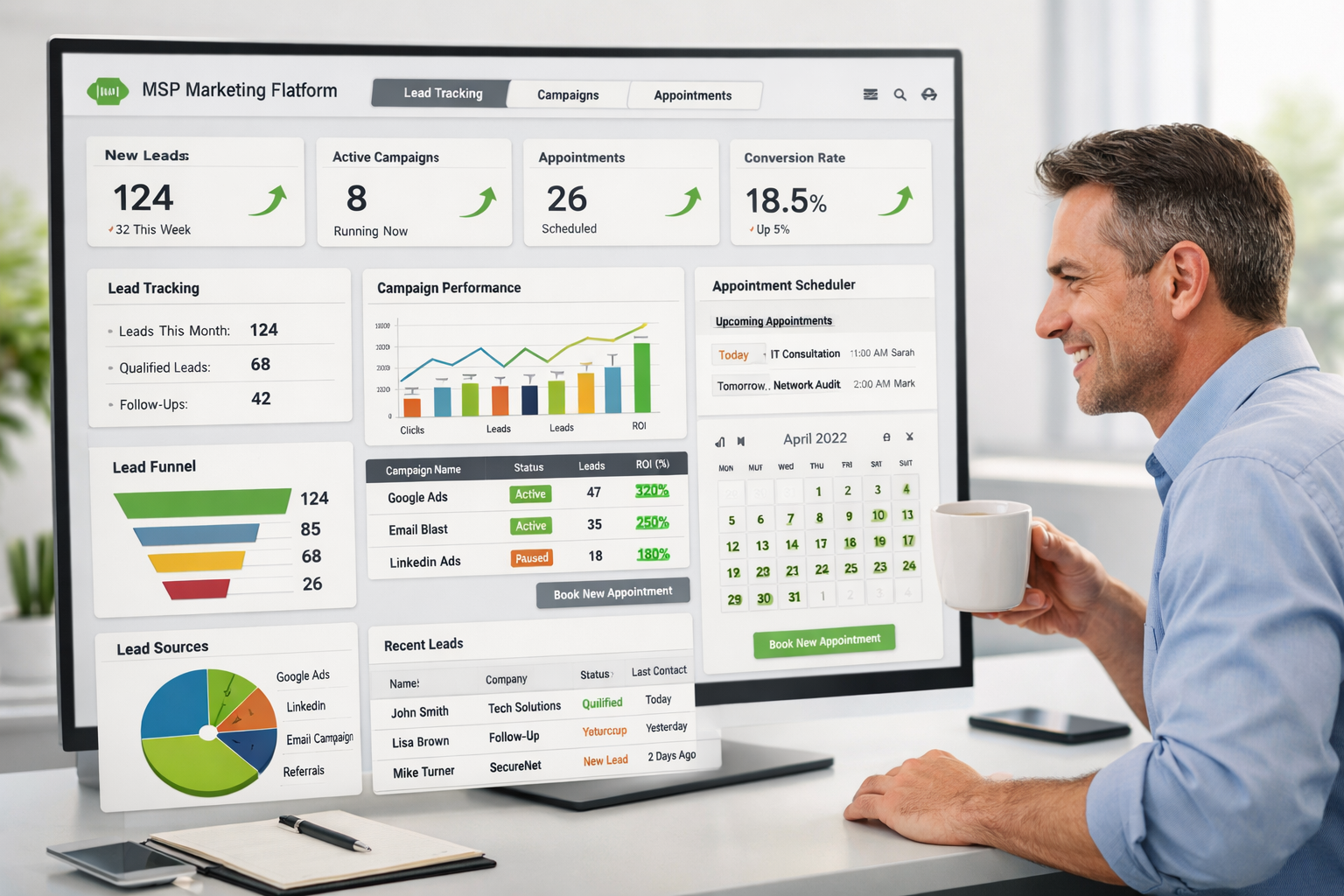
Let’s get specific about what’s probably cluttering your marketing stack right now:
Separate Email Marketing Platforms
If you’re using Mailchimp, Constant Contact, or similar tools alongside a CRM, you’re creating unnecessary work. These platforms don’t understand B2B sales cycles and force you to manually sync data.
Generic Social Media Schedulers
Tools like Hootsuite or Buffer are fine for restaurants or retail, but they don’t have MSP-specific content or LinkedIn automation features you actually need.
DIY Landing Page Builders
Unless you have dedicated marketing staff, building landing pages from scratch is a time sink. You need templates that are already optimized for MSP lead generation.
Standalone Analytics Tools
Multiple analytics dashboards just create confusion. Your marketing platform should provide all the reporting you need in one place.
Generic Lead Generation Services
Those “we’ll send you 100 leads for $500” services rarely work for MSPs. The leads are usually unqualified and don’t understand your value proposition.
Building The MSP Marketing Stack You Actually Need: A Practical Approach
Now that we’ve covered what to eliminate, let’s talk about how to build a streamlined stack that actually works.
Step 1: Audit Your Current Tools
Make a list of every marketing tool you’re currently paying for. Include:
- Monthly cost
- What it’s supposed to do
- How often do you actually use it
- Whether it integrates with your other tools
I guarantee you’ll find tools you forgot you were paying for.
Step 2: Identify Integration Gaps
Look at your customer journey from first contact to closed deal. Where are you manually copying data between systems? Where are prospects falling through the cracks? These gaps are costing you deals.
Step 3: Choose Integration Over Features
When evaluating new tools, prioritize integration over individual features. A tool that does 80% of what you need but integrates perfectly is better than one that does 100% but creates data silos.
Step 4: Implement Gradually
Don’t try to replace everything at once. Start with your biggest pain point (usually CRM + email integration) and build from there.
Real-World Example: From 8 Tools to 1 Complete System
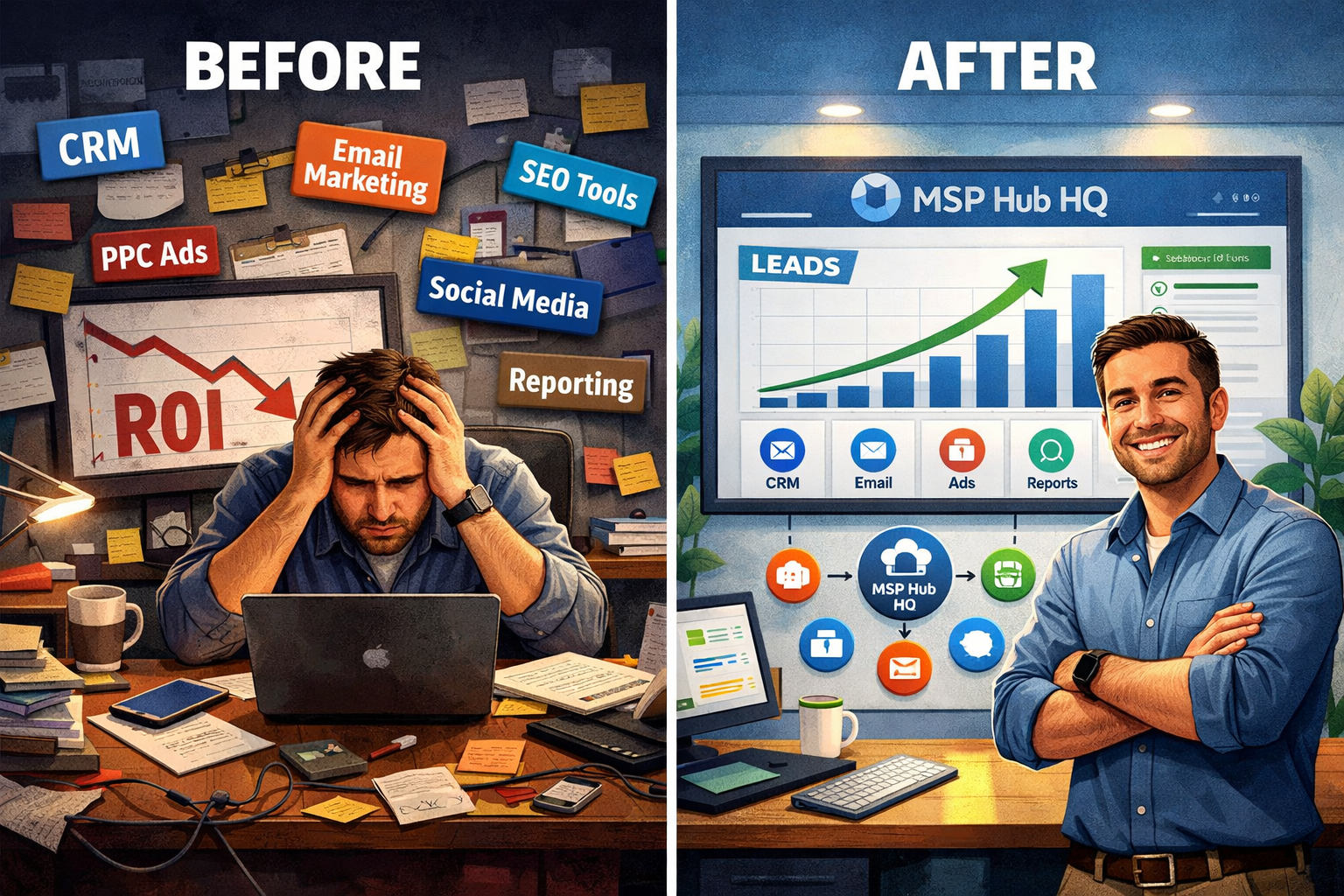
Let me tell you about Sarah, an MSP owner in Atlanta who was struggling with the exact problems we’ve been discussing.
Sarah’s Original Stack:
- Salesforce CRM: $150/month
- Mailchimp: $79/month
- Calendly: $10/month
- Hootsuite: $99/month
- Unbounce: $90/month
- Google Ads management: $200/month
- Lead tracking spreadsheets: Countless hours
- Total: $628/month + 10+ hours of manual work weekly
The Problems:
- Leads from Google Ads weren’t automatically entering Salesforce
- Email campaigns weren’t tracking which prospects became customers
- Social media posts weren’t driving measurable results
- She spent 2+ hours every Monday just updating spreadsheets
The Solution:
Sarah switched to an integrated MSP marketing platform that included:
- CRM with built-in email marketing
- Automated Google Ads management
- MSP-specific content library
- Integrated scheduling and pipeline tracking
The Results After 6 Months:
- Cost reduced to $397/month (38% savings)
- Weekly admin time down to 2 hours (80% reduction)
- Lead quality improved by 60% (better targeting)
- Appointment show-rate increased to 85% (better nurturing)
- Closed deals up 40% (improved follow-up)
This is what happens when you stop trying to patch together multiple tools and start using a complete system you own.
The Integration Advantage: Why All-in-One Beats Best-of-Breed
There’s an ongoing debate in marketing circles: should you use the “best” tool for each function, or choose an integrated platform that does everything well?
For MSPs, the answer is clear: integration wins every time.
Here’s why:
Data Consistency
When all your marketing data lives in one system, you get a single source of truth. No more wondering which system has the most up-to-date prospect information.
Automated Workflows
True automation only works when your tools can talk to each other. With an integrated system, a new lead can automatically:
- Enter your CRM
- Start receiving nurture emails
- Get scored based on their behavior
- Trigger appointment booking when they’re ready
Better Attribution
You can actually see which marketing efforts are driving revenue, not just leads. This lets you double down on what works and eliminate what doesn’t.
Reduced Training Time
Your team only needs to learn one system instead of juggling multiple platforms with different interfaces and workflows.
Common Mistakes When Choosing The MSP Marketing Stack You Actually Need
Even when MSPs decide to streamline their marketing stack, they often make these critical errors:
Mistake #1: Choosing Based on Features, Not Integration
Just because a tool has the most features doesn’t mean it’s the best choice. A tool that does everything but doesn’t integrate with your existing systems will create more problems than it solves.
Mistake #2: Underestimating Implementation Time
Switching marketing tools isn’t just about signing up for new software. You need to:
- Migrate existing data
- Set up new workflows
- Train your team
- Test everything thoroughly
Plan for 30-60 days of implementation time, not the “5-minute setup” promised in sales demos.
Mistake #3: Not Considering Your Team’s Skill Level
The most sophisticated platform in the world is useless if your team can’t use it effectively. Choose tools that match your team’s current capabilities, not where you hope they’ll be in six months.
Mistake #4: Ignoring MSP-Specific Requirements
Generic marketing platforms don’t understand that MSPs need:
- Longer nurture sequences (30-90 day sales cycles)
- Technical credibility in messaging
- Integration with PSA/RMM tools
- Compliance considerations for certain industries
Making the Switch: A Step-by-Step Implementation Plan
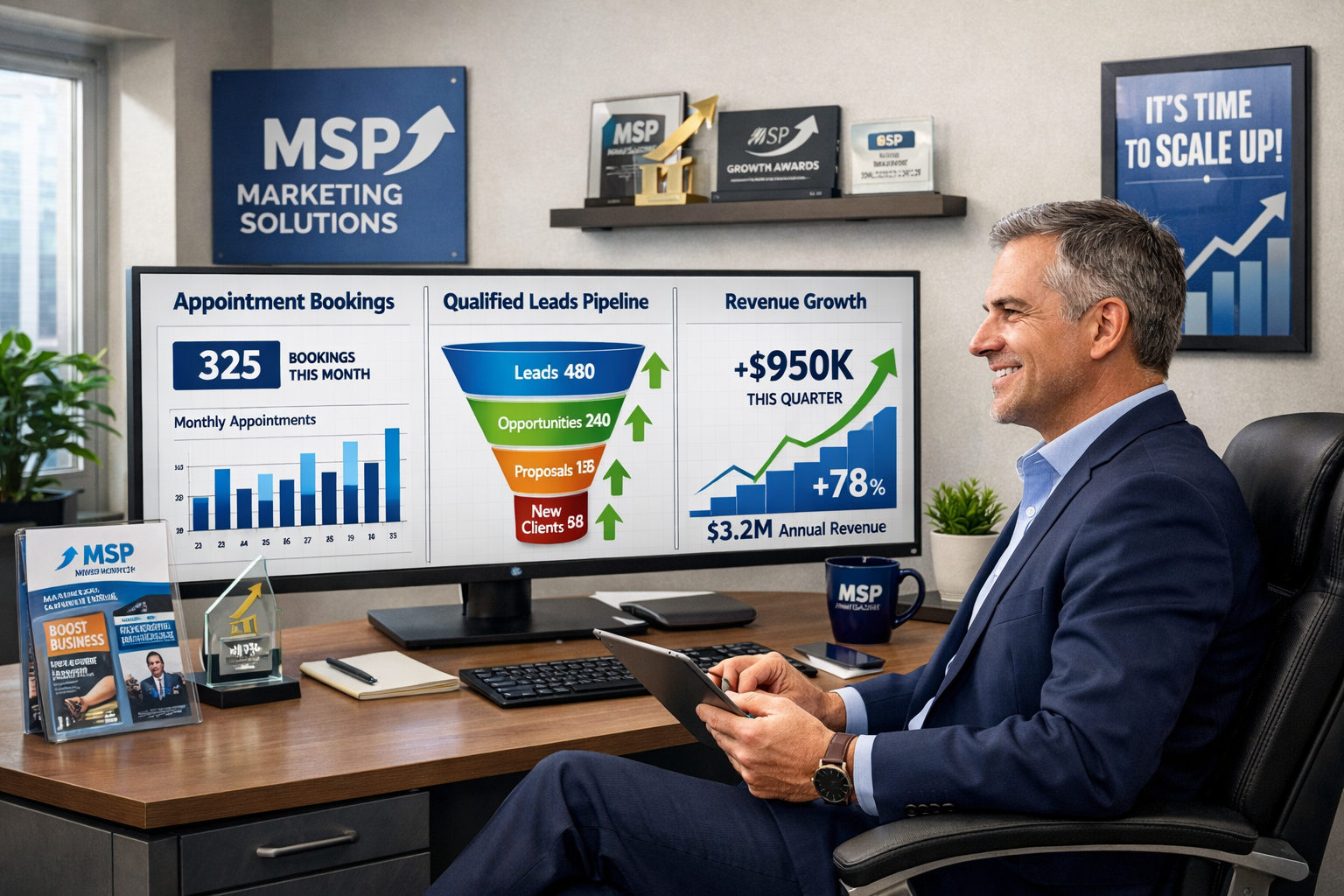
Ready to streamline your marketing stack? Here’s how to do it without disrupting your current lead flow:
Phase 1: Assessment (Week 1)
- Audit current tools and costs
- Map your current lead flow
- Identify the biggest pain points
- Set success metrics
Phase 2: Selection (Week 2-3)
- Research integrated platforms
- Request demos focused on your specific needs
- Check references from other MSPs
- Negotiate trial periods
Phase 3: Parallel Setup (Week 4-6)
- Set up a new platform alongside existing tools
- Import critical data
- Build initial campaigns
- Train key team members
Phase 4: Testing (Week 7-8)
- Run campaigns in parallel
- Compare results
- Refine workflows
- Address any integration issues
Phase 5: Full Migration (Week 9-10)
- Switch primary lead flow to the new platform
- Cancel redundant tools
- Monitor performance closely
- Fine-tune based on results
The ROI of Simplifying Your Marketing Stack
Let’s talk numbers. When you eliminate tool chaos and implement The MSP Marketing Stack You Actually Need (And What to Eliminate), here’s what typically happens:
Cost Savings
- Tool consolidation: Save $300-1500/month on redundant subscriptions
- Reduced training time: 50-75% less time onboarding new team members
- Lower maintenance overhead: Fewer vendor relationships to manage
Efficiency Gains
- Time savings: 5-10 hours/week less spent on manual data entry
- Faster campaign deployment: Launch new campaigns in hours, not days
- Better data quality: A single source of truth eliminates conflicting reports
Revenue Impact
- Improved lead quality: Better targeting and nurturing
- Higher conversion rates: Integrated follow-up sequences
- Faster sales cycles: Automated qualification and scheduling
One MSP owner told me, “We spent more money on our integrated platform than our old patchwork of tools, but we’re generating 3x more qualified appointments. The ROI is obvious.”
What Success Looks Like: The Complete System You Own
When you get The MSP Marketing Stack You Actually Need (And What to Eliminate) right, here’s what your marketing operation looks like:
Monday Morning Dashboard Review (5 minutes)
- Check lead generation metrics from the weekend
- Review scheduled appointments for the week
- Spot any campaigns that need attention
Automated Lead Nurturing
- New leads automatically enter appropriate nurture sequences
- Prospects receive MSP-specific content based on their interests
- Hot leads get prioritized for immediate follow-up
Seamless Appointment Booking
- Qualified prospects can book appointments directly
- Calendar integration prevents double-booking
- Automated reminders reduce no-shows
Clear ROI Tracking
- See which campaigns drive actual revenue, not just leads
- Track prospects from first contact to closed deal
- Make data-driven decisions about marketing spend
This is what a turn-key marketing engine looks like when it’s built by MSPs for MSPs.
Key Takeaways: Simplify to Scale
The biggest lesson here is simple: more tools don’t equal better results. In fact, tool proliferation usually creates more problems than it solves.
The MSP Marketing Stack You Actually Need (And What to Eliminate) comes down to three principles:
- Integration over features – Choose tools that work together seamlessly
- MSP-specific over generic – Use platforms built for your industry
- Automation over manual work – Let technology handle routine tasks
When you get this right, you stop relying on referrals and start building a predictable lead generation system that grows your MSP consistently.
The MSPs who are scaling successfully in 2026 aren’t the ones with the most marketing tools – they’re the ones with the right tools working together as a complete system you own.
