

Relying on Referrals Puts Your MSP at Risk in 2025
Why the Referral Trap Feels So Good (But Is So Dangerous)

Let me start with a story that might sound familiar. Last year, I worked with an MSP owner named Dave who had built his business to $2.3 million in annual revenue almost entirely through referrals. His clients loved him. His retention rate was 97%. He was the guy everyone recommended when their friend’s computer system went down.
Dave felt proud and rightfully so. Referrals are the ultimate validation that you’re doing something right. When someone stakes their reputation on recommending your services, it means you’ve earned their trust at the highest level.
But Dave had a problem he didn’t see coming.
His biggest client, a manufacturing company that represented 23% of his revenue, got acquired by a larger corporation with their own IT department. Overnight, Dave lost nearly a quarter of his business. Worse yet, that client had been his biggest referral source, responsible for sending him 4-5 new manufacturing clients over the past three years.
The referral pipeline didn’t just slow down – it stopped.
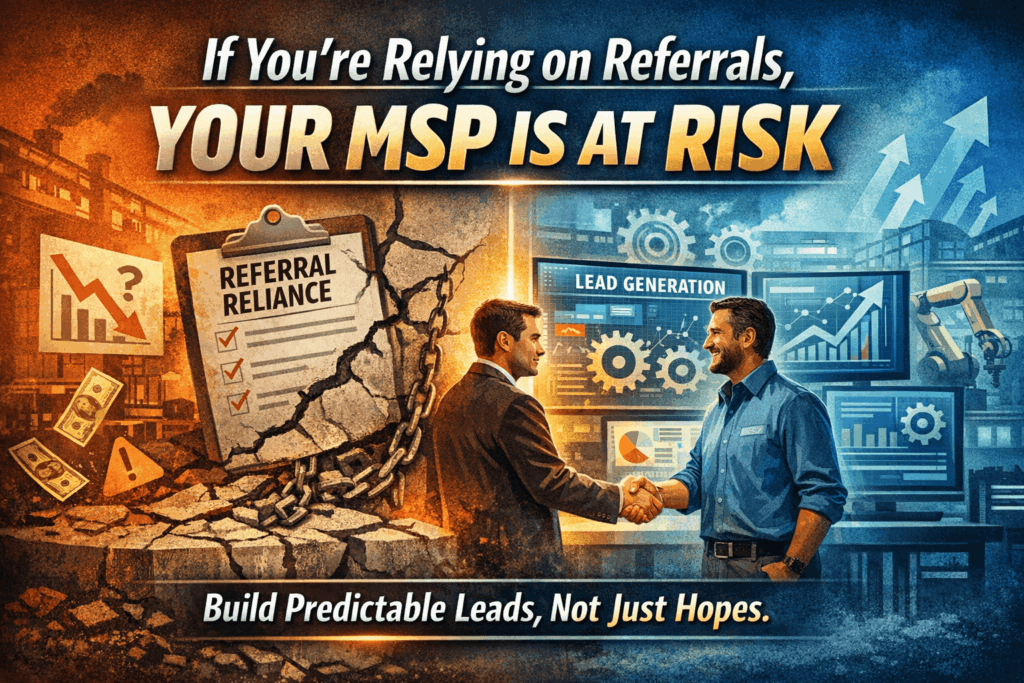
This is exactly why if you’re relying on referrals, your MSP is at risk. You’re building your business on someone else’s foundation, and when that foundation shifts, you’re left scrambling.
The Hidden Ceiling of Referral-Based Growth
Here’s what most MSP owners don’t realize about referral-based growth: it has a mathematical ceiling that’s much lower than you think.
The Referral Math That Doesn’t Add Up
Let’s break down the numbers. If you have 50 clients and each client refers one new customer per year (which would be exceptionally high), you’re looking at 50 new prospects annually. Sounds good, right?
But here’s the catch:
- Not all referrals convert (industry average is about 60-70%)
- Referrals come in unpredictable waves (feast or famine cycles)
- Your referral sources can disappear (clients move, get acquired, change leadership)
- You can’t control the timing (referrals come when they come, not when you need them)
This means you’re actually looking at maybe 30-35 new clients per year, and that’s assuming everything goes perfectly.
Why Manufacturing Companies Rarely Refer
Here’s something specific to the manufacturing sector that makes referral dependence even more risky: manufacturing companies don’t talk to each other about IT services as much as you’d think.
I’ve discovered this while working with MSPs who serve manufacturing clients. Unlike professional services firms that network constantly, manufacturing companies are often:
- Focused internally on production and operations
- Protective of operational secrets (including who provides their IT)
- Geographically isolated from similar businesses
- Time-constrained with little bandwidth for networking conversations
This means even if you’re doing amazing work for a manufacturing client, they might go years without having a conversation where referring your services would naturally come up.
The Real Cost of Referral Dependency
When you’re relying on referrals, your MSP is at risk of more than just slow growth. You’re risking:
1. Revenue Volatility
Without predictable lead generation, your revenue becomes a roller coaster. Some months you sign three new clients, other months you sign zero. This makes it nearly impossible to:
- Plan for growth investments
- Hire staff proactively
- Negotiate better vendor terms
- Build cash reserves
2. Competitive Disadvantage
While you’re waiting for referrals, your competitors are actively reaching out to your ideal prospects. They’re building relationships, demonstrating expertise, and positioning themselves as the obvious choice.
Manufacturing companies especially need this proactive approach. They’re dealing with:
- Legacy systems that need modernization
- Cybersecurity threats targeting industrial operations
- Compliance requirements that change regularly
- Operational efficiency demands that require strategic IT planning
If you’re not actively educating them about these challenges and your solutions, someone else is.
3. Limited Market Penetration
Referrals tend to come from similar types of businesses in similar situations. This creates an echo chamber that limits your market penetration.
For example, if you get into manufacturing through one mid-sized company, your referrals will likely be other mid-sized manufacturers. You might miss opportunities with:
- Larger manufacturing operations that need enterprise-level solutions
- Specialized manufacturing niches (medical devices, automotive, food processing)
- Manufacturing companies in different geographic areas
- Emerging manufacturers that are growing rapidly
Building Predictable Growth Systems That Actually Work
Here’s what I’ve learned working with MSPs who’ve successfully broken free from referral dependency: you need both inbound and outbound systems working together.
The Inbound Foundation: Becoming the Obvious Expert
Inbound marketing means creating valuable content that attracts your ideal prospects when they’re researching solutions. For MSPs targeting manufacturing, this might include:
Educational Content That Manufacturers Need:
- “The Manufacturing CIO’s Guide to Cybersecurity Compliance”
- “How Smart Factories Are Using IT to Reduce Downtime by 40%”
- “What Every Manufacturing Owner Should Know About Ransomware”
- “The Real Cost of IT Downtime in Manufacturing Operations”
The key is creating content that demonstrates your expertise in manufacturing-specific challenges. When a plant manager Googles “manufacturing cybersecurity best practices” at 11 PM after reading about another ransomware attack, your content should be the first thing they find.
The Outbound Engine: Proactive Relationship Building
Outbound marketing means actively reaching out to your ideal prospects instead of waiting for them to find you. This includes:
Targeted Outreach Strategies:
- LinkedIn campaigns targeting manufacturing executives
- Email sequences for companies showing signs they need IT help
- Direct mail campaigns to manufacturing facilities in your area
- Industry event participation and speaking opportunities
The beauty of combining inbound and outbound is that they reinforce each other. Your outbound prospects see your inbound content and think, “These people really understand our industry.”
Why MSP Hub HQ Changes the Game
Here’s where MSP Hub HQ becomes a game-changer for MSPs serious about systematic growth.
Traditional marketing tools were built for generic businesses. MSP Hub HQ was built specifically for managed service providers, with features that understand your unique challenges:
MSP-Specific Features:
- Industry-focused content templates for manufacturing and other verticals
- Automated lead scoring that understands IT buying cycles
- Integration capabilities with your existing PSA and RMM tools
- ROI tracking that shows exactly which marketing efforts generate revenue
But here’s what really sets it apart: MSP Hub HQ helps you build systems, not just campaigns.
Instead of random marketing activities, you get:
- Systematic lead generation that produces predictable results
- Automated follow-up sequences that nurture prospects over time
- Performance analytics that show exactly what’s working
- Scalable processes that grow with your business
The Manufacturing Opportunity You’re Missing
Let me share another story that illustrates why, if you’re relying on referrals, your MSP is at risk of missing huge opportunities.
I worked with an MSP that had been serving a few manufacturing clients through referrals. Good relationships, steady revenue, but nothing spectacular. Then we helped them implement a systematic approach targeting manufacturing companies specifically.
Within six months, they discovered something interesting: manufacturing companies have IT needs that most MSPs don’t even know about.
Unique Manufacturing IT Challenges:
- Industrial IoT security (protecting connected machinery)
- Supply chain system integration (connecting with vendors and customers)
- Regulatory compliance (FDA, EPA, OSHA requirements)
- Operational technology convergence (bridging IT and OT systems)
- Disaster recovery planning (for facilities that can’t afford downtime)
By positioning themselves as the MSP that truly understood manufacturing, they went from competing on price to competing on expertise. Their average contract value increased by 180%, and they started attracting larger manufacturing clients who needed strategic IT partnerships, not just technical support.
This never would have happened through referrals alone.
Creating Your Systematic Growth Plan
If you’re ready to acknowledge that relying on referrals puts your MSP at risk, here’s how to start building predictable growth systems:
Phase 1: Foundation Building (Months 1-2)
Content Strategy Development:
- Research your target manufacturing prospects’ biggest challenges
- Create a content calendar addressing these specific pain points
- Develop case studies showcasing your manufacturing expertise
- Build landing pages optimized for manufacturing search terms
System Setup:
- Implement MSP Hub HQ or a similar marketing automation platform
- Create lead scoring criteria specific to manufacturing prospects
- Set up tracking for all marketing activities
- Integrate with your existing business tools
Phase 2: Inbound Engine Launch (Months 2-4)
Content Creation:
- Publish weekly blog posts addressing manufacturing IT challenges
- Create downloadable resources (checklists, guides, assessments)
- Start an email newsletter focusing on manufacturing technology trends
- Optimize website for manufacturing-related search terms
SEO and Visibility:
- Target keywords like “manufacturing IT support,” “industrial cybersecurity,” and “factory network security.”
- Build backlinks through manufacturing industry publications
- Create Google My Business listings optimized for manufacturing searches
- Develop relationships with manufacturing industry influencers
Phase 3: Outbound Campaign Development (Months 3-5)
Targeted Outreach:
- Build lists of manufacturing companies in your service area
- Create personalized email sequences for different manufacturing segments
- Develop LinkedIn outreach campaigns targeting manufacturing executives
- Plan direct mail campaigns for high-value manufacturing prospects
Relationship Building:
- Join manufacturing industry associations
- Attend manufacturing trade shows and conferences
- Speak at manufacturing industry events
- Partner with manufacturing consultants and advisors
Phase 4: Optimization and Scaling (Months 5+)
Performance Analysis:
- Track which content generates the most qualified leads
- Analyze which outreach methods produce the best results
- Calculate ROI for different marketing activities
- Identify your most profitable manufacturing niches
System Refinement:
- Automate successful processes
- Scale up what’s working
- Eliminate what’s not producing results
- Continuously test new approaches
Real Results: What Systematic Growth Looks Like
Let me share some real numbers from MSPs who’ve made this transition:
Case Study: Midwest Manufacturing MSP
- Before: 100% referral-based, averaging 2-3 new clients per year
- After: 70% systematic marketing, 30% referrals, averaging 12-15 new clients per year
- Revenue Growth: 340% increase over 18 months
- Contract Value: Average deal size increased from $3,200/month to $8,700/month
Case Study: Regional Industrial IT Provider
- Before: Referral-dependent with unpredictable revenue swings
- After: Predictable monthly lead generation producing 15-20 qualified prospects
- Pipeline Growth: 6-month sales pipeline increased from $180K to $750K
- Market Position: Became recognized as the “manufacturing IT experts” in their region
The key difference? These MSPs stopped hoping for growth and started systematically creating it.
Overcoming Common Objections to Systematic Marketing
I know what you’re thinking. Every MSP owner I talk to has the same concerns about moving beyond referrals:
“Marketing feels too ‘salesy’ for our industry.”
The Reality: Modern marketing isn’t about being pushy – it’s about being helpful. When you create content that genuinely helps manufacturing companies solve IT problems, you’re providing value, not bothering them.
Manufacturing executives are actively searching for IT guidance. If you’re not providing it, they’re finding it somewhere else.
“We don’t have time for marketing.”
The Reality: You don’t have time NOT to do marketing. Every hour you spend on systematic marketing saves you dozens of hours you’d otherwise spend chasing referrals that may never come.
Plus, platforms like MSP Hub HQ automate most of the heavy lifting. You create the strategy once, then let the system execute it.
“Our clients prefer working with people they know.”
The Reality: This is exactly why systematic marketing works so well. Instead of being a stranger when you reach out, your prospects already know you from your content, your industry presence, and your reputation.
You’re not replacing the relationship-building aspect – you’re creating more opportunities for relationships to develop.
“Marketing is too expensive.”
The Reality: Referral dependency is far more expensive than marketing. When you lose a major referral source, the revenue impact can be devastating. Marketing is an investment that pays dividends for years.
Consider this: If systematic marketing helps you sign just one additional $5,000/month manufacturing client, that’s $60,000 in annual revenue. Most comprehensive marketing systems cost a fraction of that.
The Technology Stack for Systematic MSP Growth
Here’s the technology infrastructure you need to build predictable growth systems:
Core Marketing Platform: MSP Hub HQ
Why MSP Hub HQ Works for Manufacturing-Focused MSPs:
- Industry-specific templates for manufacturing content and campaigns
- Lead scoring algorithms that understand manufacturing buying cycles
- Integration capabilities with popular MSP tools (ConnectWise, Autotask, etc.)
- ROI tracking that shows exactly which marketing efforts drive revenue
- Automated workflows that nurture prospects without constant manual work
Supporting Tools and Integrations
Content Creation:
- Canva or Adobe Creative Suite for visual content
- Grammarly for content quality assurance
- BuzzSumo for content research and trending topics
- Google Analytics for website performance tracking
Outbound Outreach:
- LinkedIn Sales Navigator for prospect research
- Mailchimp or Constant Contact for email marketing
- Calendly for automated meeting scheduling
- Zoom for virtual meetings and webinars
CRM and Sales:
- HubSpot or Salesforce for comprehensive lead management
- Pipedrive for simple, effective sales pipeline tracking
- DocuSign for contract management
- QuickBooks for financial tracking and ROI analysis
Measuring What Matters
Key Performance Indicators (KPIs) for MSP Marketing:
| Metric | Target Range | Why It Matters |
|---|---|---|
| Website Traffic Growth | 15-25% monthly | Indicates content effectiveness |
| Lead Generation Rate | 20-30 qualified leads/month | Shows marketing system health |
| Lead-to-Customer Conversion | 15-25% | Measures sales process efficiency |
| Customer Acquisition Cost | $500-$1,500 | Ensures profitable growth |
| Average Contract Value | $3,000-$8,000/month | Tracks market positioning |
| Sales Cycle Length | 30-90 days | Indicates process optimization |
The beauty of systematic marketing is that everything becomes measurable and improvable.
Building Your Manufacturing-Focused Content Strategy
Since we’re specifically targeting manufacturing companies, let’s dive deeper into the content strategy that actually works for this audience.
Understanding Manufacturing Decision-Makers
Primary Decision-Makers in Manufacturing IT:
- Plant Managers (focused on operational efficiency)
- Operations Directors (concerned with system integration)
- CFOs (interested in cost control and ROI)
- CEOs (worried about competitive advantage)
- IT Managers (if they exist – many manufacturers don’t have dedicated IT staff)
Each of these personas needs different types of content addressing their specific concerns.
Content Topics That Resonate with Manufacturing
Operational Efficiency Content:
- “How Modern IT Infrastructure Reduces Manufacturing Downtime”
- “The Real Cost of Legacy Systems in Manufacturing Operations”
- “5 Ways Cloud Computing Improves Manufacturing Flexibility”
- “Integrating IoT Sensors with Your Manufacturing IT Infrastructure”
Security and Compliance Content:
- “Manufacturing Cybersecurity: Protecting Your Production Floor”
- “NIST Framework Implementation for Manufacturing Companies”
- “How to Secure Industrial Control Systems from Cyber Attacks”
- “Compliance Automation: Making Regulatory Requirements Manageable”
Strategic Growth Content:
- “Using Technology to Scale Manufacturing Operations”
- “The Manufacturing CIO’s Guide to Digital Transformation”
- “How Smart Manufacturers Use Data Analytics for Competitive Advantage”
- “Building Resilient Supply Chain Technology Systems”
Content Distribution Strategy
Multi-Channel Approach:
- Company blog optimized for manufacturing search terms
- LinkedIn articles targeting manufacturing executives
- Industry publications through guest posting and contributed articles
- Email newsletters with manufacturing-specific insights
- Webinars and virtual events addressing manufacturing IT challenges
- Podcast appearances on manufacturing and business shows
The Future of MSP Growth Is Systematic

Here’s what I want you to understand: if you’re relying on referrals, your MSP is at risk not just of slow growth, but of becoming irrelevant in a rapidly changing market.
The MSPs that will thrive in 2025 and beyond are those that build systematic, predictable growth engines. They’re not hoping for referrals – they’re creating opportunities.
What the Next 12 Months Could Look Like
If you continue relying on referrals:
- Unpredictable revenue swings
- Vulnerability to losing major clients
- Limited market penetration
- Competing primarily on price
- Constant stress about where the next client will come from
If you build systematic growth systems:
- Predictable monthly lead generation
- Diversified client base reducing risk
- Premium pricing based on expertise
- Market positioning as the manufacturing IT expert
- Confidence in your business’s future
The choice is yours, but the window for building these systems is narrowing. Every month you wait is another month your competitors are building stronger market positions.
Taking Action: Your Next Steps
If you’re ready to stop putting your MSP at risk by relying solely on referrals, here’s exactly what to do:
Immediate Actions (This Week)
- Audit your current lead sources – What percentage comes from referrals vs. other sources?
- Research your manufacturing prospects – Who are the ideal manufacturing companies in your area?
- Evaluate your content – Do you have any content specifically addressing manufacturing IT challenges?
- Check your competition – Are other MSPs actively targeting manufacturing in your market?
Short-Term Actions (Next 30 Days)
- Set up MSP Hub HQ or similar marketing automation platform
- Create your first piece of manufacturing-focused content
- Build a list of 100 manufacturing prospects in your service area
- Optimize your website for manufacturing-related search terms
- Join one manufacturing industry association or online community
Long-Term Actions (Next 90 Days)
- Launch your content marketing strategy with weekly manufacturing-focused articles
- Begin targeted outbound campaigns to manufacturing prospects
- Attend your first manufacturing industry event
- Develop strategic partnerships with manufacturing consultants or vendors
- Track and optimize your marketing performance
Conclusion
The harsh reality is this: if you’re relying on referrals, your MSP is at risk of hitting growth ceilings, revenue volatility, and competitive disadvantage that could permanently limit your business potential.
But here’s the opportunity: Manufacturing companies desperately need MSPs who understand their unique challenges. They’re dealing with cybersecurity threats, legacy system modernization, compliance requirements, and operational efficiency demands that require specialized IT expertise.
The MSPs who build systematic marketing approaches to reach these prospects won’t just grow faster – they’ll build more valuable, more resilient businesses that don’t depend on hoping existing clients remember to refer them.
The question isn’t whether you should build these systems. The question is whether you’ll build them before your competitors do.
Your business deserves better than hoping for referrals. Your manufacturing prospects deserve better than stumbling across your services by accident. And you deserve the confidence that comes with predictable, systematic growth.
The tools exist. The opportunity is massive. The only thing missing is your decision to start.
What will you choose?
