

Why Most MSPs Struggle to Generate Leads (And How to Fix It)

The Hidden Reasons Why Most MSPs Struggle to Generate Leads
The Technical Expertise Trap
Here’s something I’ve observed after working with hundreds of MSPs: the very skills that make you exceptional at managing IT infrastructure often work against you in marketing. You’re trained to think in terms of specifications, configurations, and technical solutions. But your prospects? They’re business owners who lose sleep over operational efficiency, not RAM specifications.
A few months ago, I met an MSP owner named Jason. Technically, he was brilliant. He handled multi-site migrations, configured complex security stacks, and could troubleshoot issues most engineers would escalate three levels up.
But despite all that expertise, his lead flow was almost nonexistent. His website read like a technical manual, packed with terminology his prospects didn’t understand. His proposals focused on tools and configurations instead of outcomes. His messaging simply didn’t connect with business owners.
Once we reframed his messaging around productivity, risk reduction, and predictable growth, everything changed. Jason didn’t become better at IT. He became better at communicating the value of IT.
The reality check: Your prospects don’t buy technology; they buy peace of mind, productivity gains, and competitive advantages. When your marketing speaks in IT language instead of business language, you’re essentially speaking a foreign language to your ideal clients.
The Referral Dependency Syndrome
Many MSPs become addicted to referral-based growth. It feels natural for satisfied clients to recommend you to their business contacts, and these warm introductions often convert well. But here’s the dangerous part: referral dependency creates a false sense of security while limiting your growth potential.
Why referral-only strategies fail:
- Unpredictable timing: You can’t control when referrals happen
- Limited scalability: Referrals grow linearly, not exponentially
- Narrow market reach: You only access your existing network’s connections
- Vulnerability to economic shifts: When clients tighten budgets, referrals dry up first
The MSPs who thrive in 2025 treat referrals as a bonus, not a business strategy. They’ve built systematic lead generation engines that work independently of their existing client relationships.
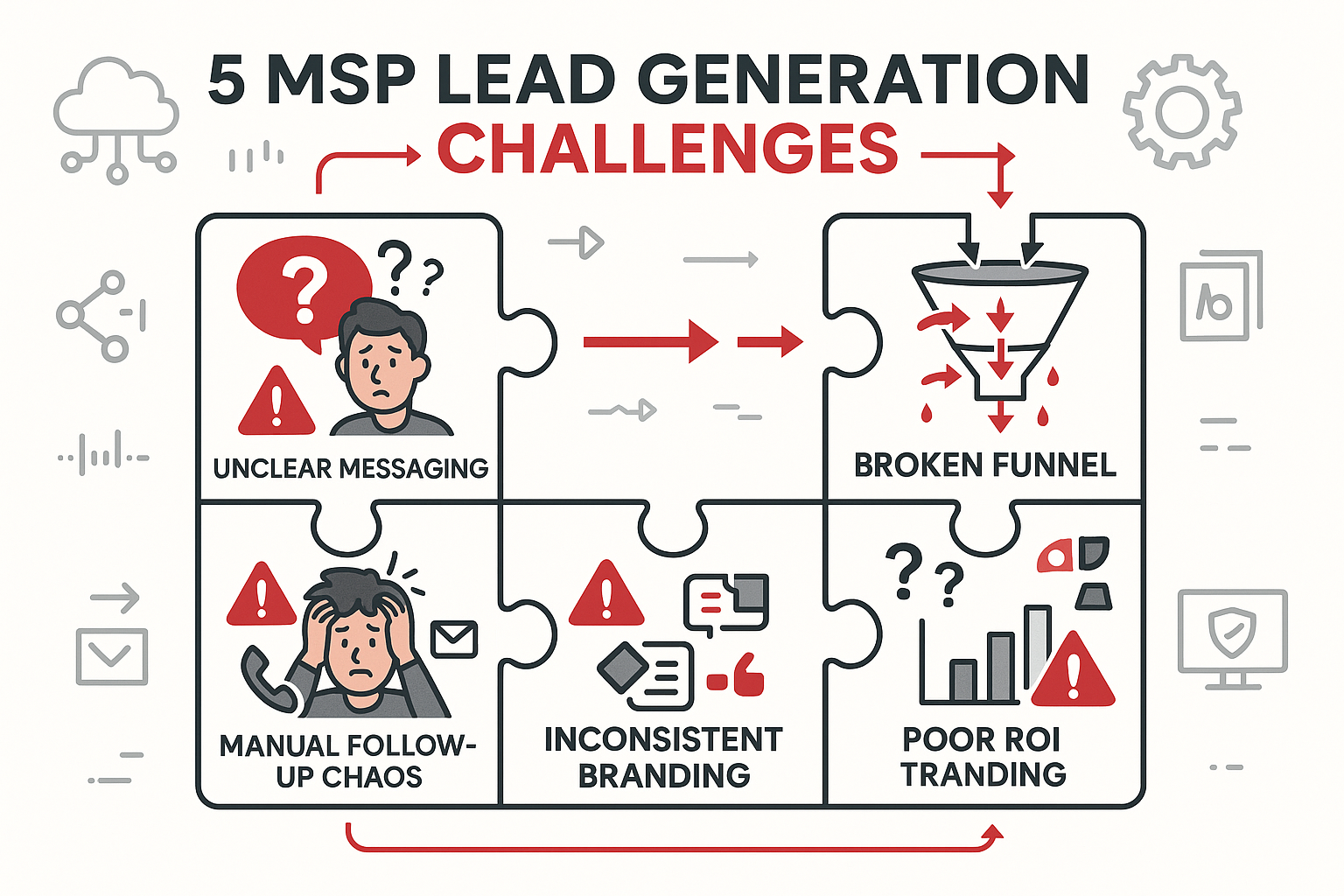
The Core Challenges: Why Most MSPs Struggle to Generate Leads Consistently
1. Messaging That Misses the Mark
The Problem: Your website probably sounds like every other MSP’s website. Generic phrases like “comprehensive IT solutions,” “cutting-edge technology,” and “24/7 support” don’t differentiate you or connect with real business pain points.
Let me share a story that illustrates this perfectly. Sarah, an MSP owner in Denver, was competing for a contract with a growing law firm. Her proposal was technically superior to her competitors’, but she lost the deal. Why? Her presentation focused on server specifications and security protocols, while the winning MSP talked about “helping lawyers focus on winning cases instead of worrying about technology failures.”
The Fix: Outcome-Based Messaging
Transform your technical features into business benefits:
| Instead of Saying | Say This |
|---|---|
| “We provide 24/7 network monitoring” | “We prevent the 3 AM phone calls that ruin your weekend” |
| “Enterprise-grade cybersecurity solutions” | “Sleep better knowing your client data is protected from ransomware” |
| “99.99% uptime guarantee” | “Keep your team productive and your customers happy” |
| “Cloud migration services” | “Access your files from anywhere while cutting IT costs by 30%” |
Action Step: Rewrite your homepage headline to answer this question: “What specific business problem do you solve, and what does success look like for your clients?”
2. The Broken Funnel Problem
Most MSPs don’t have a funnel; they have a cliff. Prospects either buy immediately (rare) or disappear forever (common). There’s no middle ground, no nurturing process, and no systematic way to build relationships over time.
What a proper MSP funnel looks like:
Top of Funnel (Awareness Stage):
- Educational blog content about cybersecurity threats
- SEO-optimized pages for local IT support searches
- Social media content showcasing client success stories
- Speaking at local business events
Middle of Funnel (Consideration Stage):
- Lead magnets like “IT Security Checklist for Small Business”
- Email sequences that educate about common IT challenges
- Webinars on topics like “Preparing for Cyber Attacks”
- Case studies showing measurable business improvements
Bottom of Funnel (Decision Stage):
- Free IT assessments or network audits
- Detailed proposals with clear ROI projections
- Client testimonials and references
- Trial periods or pilot projects
The Missing Link: Most MSPs jump straight from awareness to sales pitch. They skip the crucial relationship-building phase where prospects learn to trust your expertise and understand your value.
3. Manual Processes That Don’t Scale
I’ve seen MSP owners personally responding to every website inquiry, manually sending follow-up emails, and trying to remember which prospects they’ve contacted. This approach might work when you’re getting five leads per month, but it becomes impossible at scale.
Common Manual Process Mistakes:
- No lead scoring system: All inquiries get the same treatment
- Inconsistent follow-up: Some prospects get forgotten in the chaos
- No nurturing sequences: Cold leads never get warmed up
- Manual appointment scheduling: Phone tag wastes everyone’s time
The Automation Solution:
Implement these automated systems:
- Lead Capture Automation: Forms that automatically segment prospects based on company size, industry, and needs
- Email Nurturing Sequences: Automated campaigns that deliver value over time
- Lead Scoring: Systems that identify hot prospects based on behavior
- Appointment Scheduling: Calendar links that eliminate back-and-forth emails
- CRM Integration: Automatic lead distribution to sales team members
Real Example: One of our clients automated their initial response sequence and saw their lead-to-appointment conversion rate increase from 12% to 34% within 60 days.
4. The ROI Blindness Challenge
Ask most MSP owners where their best leads come from, and you’ll get vague answers like “mostly referrals and some Google stuff.” This lack of tracking makes it impossible to optimize marketing spend or double down on what’s working.
What You Should Be Tracking:
Lead Source Metrics:
- Cost per lead by channel (Google Ads, SEO, referrals, events)
- Lead quality scores by source
- Conversion rates from lead to opportunity
- Average deal size by lead source
- Time from lead to close by channel
Funnel Performance:
- Website conversion rates by page
- Email open and click-through rates
- Content engagement metrics
- Appointment show-up rates
- Proposal acceptance rates
Business Impact:
- Customer acquisition cost (CAC)
- Customer lifetime value (CLV)
- Monthly recurring revenue (MRR) growth
- Churn rate by acquisition channel
Pro Tip: Use UTM parameters on all your marketing links to track exactly which campaigns, content pieces, and channels drive the best results.
5. Brand Inconsistency That Kills Trust
Your brand is more than your logo; it’s every touchpoint a prospect has with your business. Inconsistent branding signals unprofessionalism and makes prospects question your attention to detail.
Common Branding Mistakes:
- Outdated website design: Nothing says “unreliable IT provider” like a website from 2015
- Inconsistent messaging: Your website, proposals, and sales calls tell different stories
- Poor visual identity: Mismatched colors, fonts, and imagery across platforms
- Generic stock photos: Pictures of random people in suits don’t build trust
- Unprofessional email signatures: Missing contact info or broken formatting
The Trust-Building Brand Elements:
- Professional Website: Modern design that works perfectly on mobile devices
- Consistent Visual Identity: Same colors, fonts, and style across all materials
- Clear Value Proposition: Instantly understandable explanation of what you do
- Social Proof: Client testimonials, case studies, and industry certifications
- Professional Photography: Real photos of your team and office space
The MSP Lead Generation Solution Framework
Building Your Foundation: The SCALE Method
I’ve developed a framework called SCALE that addresses each of the core challenges we’ve discussed:
S – Strategic Messaging C – Conversion Funnels
A – Automation Systems L – Lead Tracking E – Engagement Consistency
Let’s break down each component:
Strategic Messaging That Converts
Your messaging strategy should follow this hierarchy:
- Primary Value Proposition: The main benefit you deliver
- Supporting Benefits: Secondary advantages of working with you
- Proof Points: Evidence that you deliver on your promises
- Differentiation: What makes you different from competitors
Example Messaging Hierarchy:
Primary Value Proposition: “We eliminate IT headaches so you can focus on growing your business”
Supporting Benefits:
- Proactive monitoring prevents problems before they impact your team
- Cybersecurity expertise protects your reputation and client data
- Strategic IT planning aligns technology with business goals
Proof Points:
- 99.97% average uptime across all clients
- Zero successful ransomware attacks in 5+ years
- Average 23% productivity improvement within 90 days
Differentiation: “Unlike break-fix providers, we become your strategic IT partner, not just your emergency contact”
Conversion Funnels That Work
The MSP-Specific Funnel Structure:
Stage 1: Problem Awareness
- Content: “5 Signs Your Business Needs Better IT Support”
- Goal: Help prospects recognize they have a problem
- Call-to-Action: Download educational resources
Stage 2: Solution Education
- Content: “How Proactive IT Management Saves Money”
- Goal: Position managed services as the solution
- Call-to-Action: Subscribe to the newsletter or attend the webinar
Stage 3: Provider Evaluation
- Content: “Questions to Ask When Choosing an MSP”
- Goal: Establish your evaluation criteria as the standard
- Call-to-Action: Request a free IT assessment
Stage 4: Decision Support
- Content: Case studies and ROI calculators
- Goal: Justify the decision
- Call-to-Action: Schedule strategy consultation
Automation Systems That Scale
Essential Automation Workflows:
New Lead Welcome Series:
- Immediate: Thank you email with next steps
- Day 1: Educational content about IT challenges
- Day 3: Case study relevant to their industry
- Day 7: Invitation to schedule consultation
- Day 14: Follow-up with additional resources
Consultation No-Show Sequence:
- Immediate: “We missed you” email with reschedule link
- Day 1: Value-focused follow-up with testimonial
- Day 7: Final attempt with special offer
Proposal Follow-Up Series:
- Day 1: Proposal delivery confirmation
- Day 3: “Questions about your proposal?”
- Day 7: Client success story similar to their situation
- Day 14: Implementation timeline and next steps
Real-World Success Stories: MSPs Who Fixed Their Lead Generation
Case Study 1: The Texas Transformation
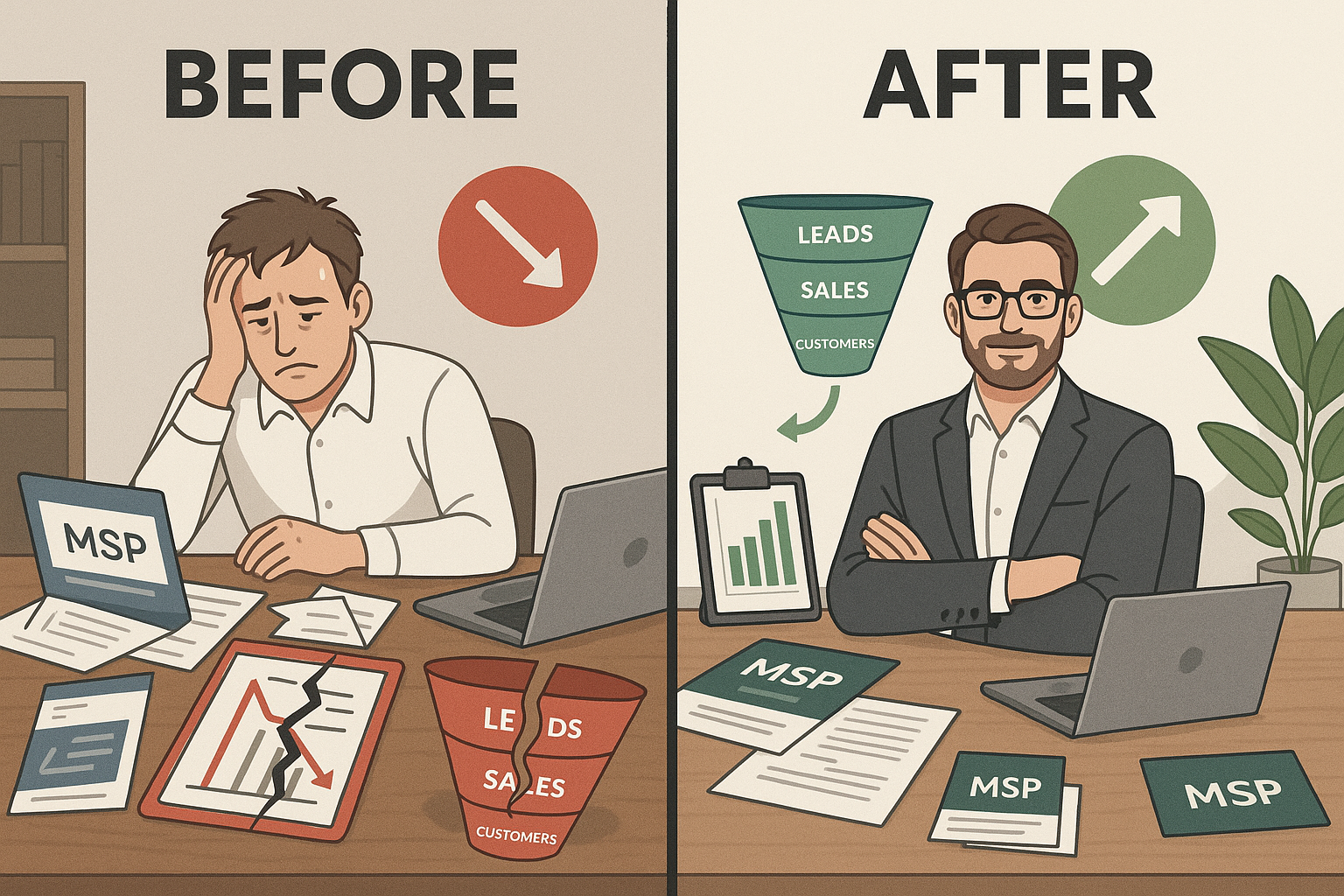
Let me tell you about David, who runs a 6-person MSP in Austin. When we first met, his lead generation was completely dependent on referrals. He was getting maybe 2-3 qualified leads per month, and his revenue had plateaued at around $800K annually.
The Challenge: David’s website looked like it was built in 2010, his messaging was full of technical jargon, and he had no systematic way to follow up with prospects. He was losing deals to competitors who weren’t necessarily better but presented themselves more professionally.
The Solution: We implemented the complete SCALE framework:
- Rewrote his messaging to focus on business outcomes
- Built a proper funnel with educational content and lead magnets
- Automated his follow-up with email sequences and CRM integration
- Implemented tracking to measure what was working
- Refreshed his brand with professional design and consistent messaging
The Results:
- Website traffic increased by 58% in 90 days
- Lead generation jumped from 2-3 to 13-15 qualified leads per month
- Conversion rate improved from 15% to 28%
- Closed 6 new contracts worth $120K in annual recurring revenue
- Reduced time spent on marketing from 15 hours/week to 3 hours/week
The Key Insight: David’s technical skills were never the problem. He just needed a marketing system that worked as systematically as the IT solutions he provided to clients.
Case Study 2: The Competitive Market Victory
Sarah runs an MSP in a highly competitive market in Southern California. She was struggling to differentiate herself from dozens of other providers, and price competition was eating into her margins.
The Challenge: Every MSP in her area offered similar services at similar prices. Prospects were making decisions based primarily on cost, which forced her into a race to the bottom.
The Solution: Instead of competing on price, we positioned Sarah as the cybersecurity specialist for professional services firms.
Strategic Changes:
- Niche Positioning: Focused exclusively on law firms, accounting practices, and consulting companies
- Specialized Content: Created cybersecurity guides specific to professional services compliance requirements
- Industry Expertise: Developed case studies showing how cybersecurity breaches could destroy professional practices
- Premium Positioning: Raised prices while emphasizing the cost of security failures
The Results:
- Average deal size increased from $3,200/month to $5,800/month
- Closed rate improved from 22% to 41%
- Reduced sales cycle from 89 days to 34 days
- Achieved a 94% client retention rate
- Built a waiting list of prospects wanting to work with her
The Key Insight: When you become the obvious choice for a specific type of client, price becomes less important than expertise and trust.
Case Study 3: The Automation Success
Mike was drowning in manual processes. His MSP was successful, but he was personally involved in every aspect of lead generation and sales. He couldn’t take a vacation without worrying about missed opportunities.
The Challenge: Mike was the bottleneck in his own business. Every lead required his personal attention, every follow-up was manual, and he had no visibility into his sales pipeline.
The Solution: We built a comprehensive automation system that could run his lead generation without constant oversight.
Automation Implementation:
- Lead Capture: Smart forms that automatically segment prospects
- Immediate Response: Automated email sequences triggered by specific actions
- Lead Scoring: A System that identifies hot prospects automatically
- Pipeline Management: CRM automation that moved leads through stages
- Appointment Setting: Calendar integration that eliminated phone tag
The Results:
- Reduced personal time spent on lead management from 25 hours/week to 6 hours/week
- Increased lead response time from 4+ hours to under 5 minutes
- Improved lead nurturing consistency by 100%
- Took a 3-week vacation without any drop in lead generation
- Scaled from a 1-person sales team to a 3-person team using the same systems
The Key Insight: Automation doesn’t replace personal relationships—it makes them possible at scale by handling routine tasks systematically.
The Technology Stack: Tools That Actually Work for MSPs
Start Here: MSPHubHQ As Your Lead Generation Engine
Before we talk about individual tools, it is important to understand that MSPHubHQ is designed to be the central engine that replaces a messy stack of disconnected apps.
MSPHubHQ gives MSPs:
A built-in CRM tailored to MSP sales cycles
Prebuilt Google and Meta ad campaigns with negative keywords
Done-for-you funnels, landing pages, and lead magnets
Automated email, SMS, and pipeline follow-up sequences
Calendar booking, call tracking, and reporting in one place
Instead of stitching together five or six separate platforms, MSPHubHQ pulls everything into a single system so you can focus on closing deals instead of managing tools.
If you are not using MSPHubHQ yet, here is what a typical tech stack looks like when you try to assemble it on your own.
Essential Lead Generation Tools
CRM Systems
MSPHubHQ CRM: Built on a proven marketing automation backbone, with pipelines, tasks, SMS, email, and reporting tailored for MSP lead generation.
HubSpot: Free tier available, excellent for small MSPs that want a standalone CRM.
Pipedrive: Simple, visual pipeline management.
Salesforce: Powerful but complex, better for larger MSPs with dedicated admins.
Email Marketing Automation
MSPHubHQ Automations: Prebuilt nurture sequences, appointment reminders, and reactivation campaigns designed specifically for MSP offers and lead magnets.
ActiveCampaign: Strong behavioral automation if you prefer a separate system.
Mailchimp: Good starter option with basic automation features.
ConvertKit: Excellent for content-driven nurturing and newsletters.
Website and Landing Pages
MSPHubHQ Funnels & Sites: Ready-to-use MSP landing pages, webinar funnels, and lead magnet pages that plug directly into your CRM and automations.
WordPress + Elementor: Flexible and cost-effective if you are building everything manually.
Unbounce: Specialized for high-converting standalone landing pages.
HubSpot CMS: Integrated with HubSpot CRM for seamless tracking.
Lead Generation Tools
MSPHubHQ Forms & Chat: Native forms, surveys, web chat, and pop-ups that feed directly into your pipelines and automations.
OptinMonster: Advanced lead capture forms if you want a separate layer on top of your site.
Calendly: Automated appointment scheduling and reminders.
Drift: Website chat and lead qualification for larger teams.
Analytics and Tracking
MSPHubHQ Reporting: Attribution, pipeline reports, ad performance, and campaign dashboards in one place so you can see which channels generate the best MSP clients.
Google Analytics 4: Essential website analytics and traffic insights.
CallRail: Phone call tracking and recording.
Hotjar: User behavior analysis and heatmaps to improve conversion.
The Integration Strategy
The key isn’t just having the right tools. It’s making them work together in a seamless, automated system. Most MSPs struggle not because the tools are bad, but because nothing is connected, tracked, or optimized.
How Successful MSPs Integrate Their Tech Stack
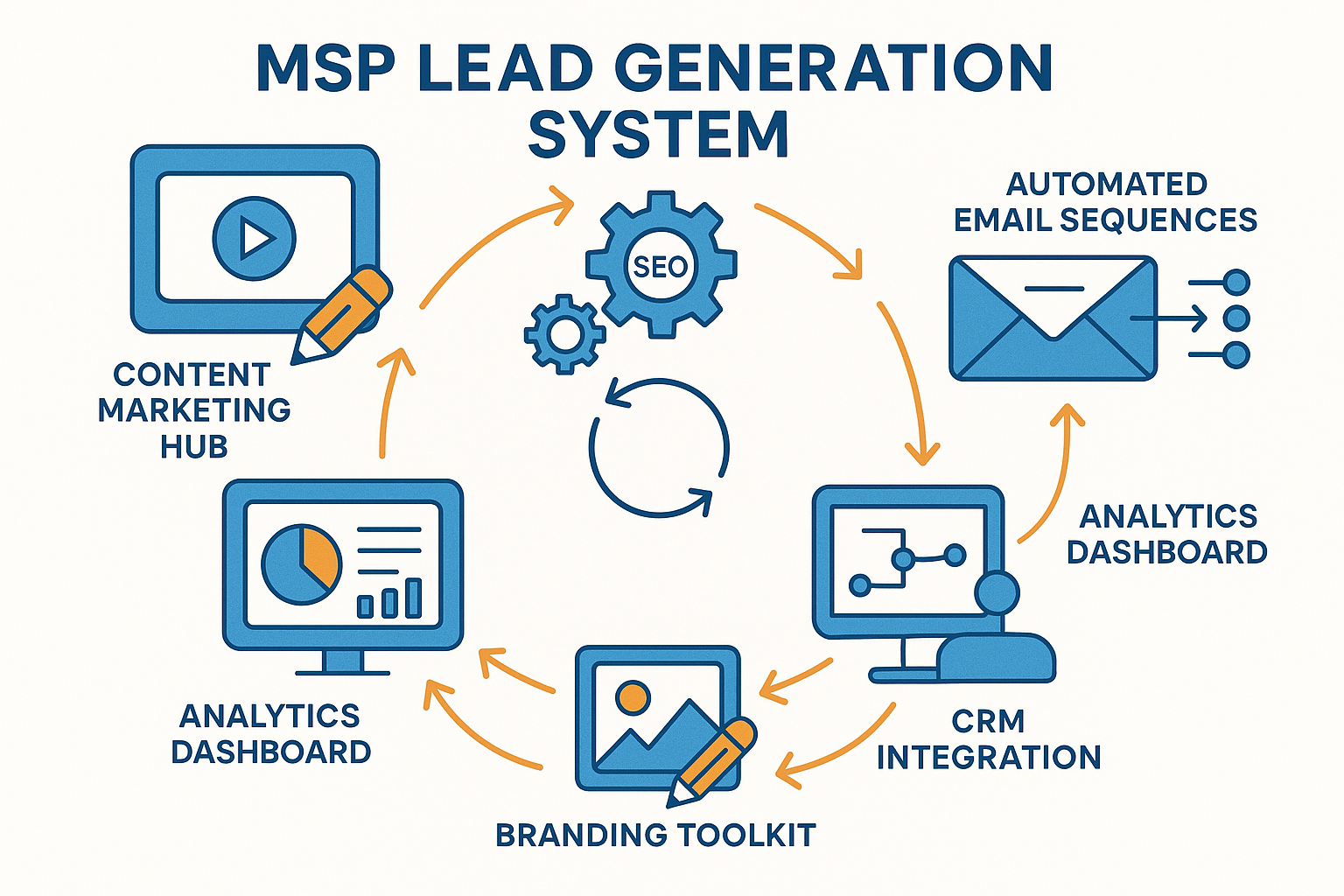
Website captures leads → CRM stores and scores them
Email automation nurtures prospects → Calendar tool handles scheduling
Analytics track performance → Regular optimization improves results
That’s the theory. But here’s the problem:
Most MSPs try to stitch together tools from six different platforms and end up with a broken funnel, duplicate data, and inconsistent follow-up.
How MSPHubHQ Solves This: Full Integration, Done for You
MSPHubHQ eliminates the complexity. Instead of forcing you to glue tools together, the platform becomes the hub of your entire marketing and lead generation system.
With MSPHubHQ, everything is already integrated for you:
1. Your Website Is Fully Built and Connected to Your CRM
We design or rebuild your MSP website
All forms, chat widgets, pop-ups, and landing pages feed directly into your CRM
Every lead is automatically tagged, scored, and placed in the correct pipeline
No plug-ins. No APIs. No broken forms.
Just a clean, connected system from day one.
2. Your Automation System Runs Behind the Scenes
New lead welcome sequences
Webinar and lead magnet funnels
Appointment reminders
Missed call text-back
Nurture sequences for cold leads
Reactivation campaigns
Everything is prewired and ready to use. You don’t have to configure anything unless you want to.
3. Your Calendar, Pipelines, and Reporting Are Unified
MSPHubHQ replaces tools like Calendly, Mailchimp, Pipedrive, Drift, and CallRail with one integrated platform:
Scheduling → inside the platform
Email/SMS automation → inside the platform
Pipeline management → inside the platform
Call tracking → inside the platform
Attribution and analytics → inside the platform
No syncing issues. No double entry. No data loss.
4. You Get Built-For-MSPs Funnels and Lead Magnets
We pre-install everything an MSP needs to generate leads:
Google ad funnels
Meta/FB ad funnels
Cybersecurity checklist lead magnets
Database reactivation campaigns
Cold outreach follow-up sequences
Sales pipelines for MSP services
You are not starting from scratch. You start with a complete, working system.
Advanced Strategies: Taking Your Lead Generation to the Next Level
Content Marketing That Converts
Most MSPs approach content marketing wrong. They write about technical topics that only other IT professionals care about. Instead, focus on business-relevant content that addresses real pain points.
High-Converting Content Topics:
- “The True Cost of Downtime: What 1 Hour Offline Really Costs Your Business”
- “Cybersecurity Insurance: What It Covers (And What It Doesn’t)”
- “How to Prepare Your Business for Remote Work Security Challenges”
- “The Business Owner’s Guide to IT Budgeting”
- “Signs Your Current IT Provider Isn’t Meeting Your Needs”
Content Distribution Strategy:
- Blog posts optimized for search engines
- LinkedIn articles targeting business decision-makers
- Email newsletters with practical tips and insights
- Speaking opportunities at local business events
- Podcast appearances on business and entrepreneurship shows
Strategic Partnerships That Generate Referrals
Build relationships with professionals who serve your ideal clients but don’t compete with you:
High-Value Partnership Opportunities:
- Business consultants who recommend technology improvements
- Accounting firms that need cybersecurity expertise for clients
- Insurance agents selling cyber liability policies
- Commercial real estate agents working with growing businesses
- Business attorneys handling mergers and acquisitions
Partnership Development Process:
- Identify potential partners in your local market
- Create value first by referring business to them
- Develop joint educational content or workshops
- Establish formal referral agreements with clear terms
- Track and optimize partnership performance
Local SEO Domination
Most businesses search for IT support locally. Dominating local search results can provide a steady stream of qualified leads.
Local SEO Checklist:
- Google Business Profile is fully optimized with photos and reviews
- Local directory listings (Yelp, Yellow Pages, industry directories)
- Location-specific content (“IT Support in [Your City]”)
- Local business citations with consistent NAP (Name, Address, Phone)
- Community involvement that generates local backlinks
Review Generation Strategy:
- Systematic review requests after successful projects
- Multiple platform presence (Google, Yelp, industry sites)
- Review the response protocol for both positive and negative feedback
- Review showcasing on the website and marketing materials
Measuring Success: KPIs That Matter for MSP Lead Generation
Primary Metrics to Track
Lead Generation Metrics:
- Monthly Qualified Leads (MQLs): Prospects who meet your ideal client criteria
- Cost Per Lead (CPL): Total marketing spend divided by the number of leads
- Lead Source Performance: Which channels produce the highest quality leads
- Website Conversion Rate: Percentage of visitors who become leads
Sales Conversion Metrics:
- Lead-to-Opportunity Rate: Percentage of leads that become sales opportunities
- Opportunity-to-Close Rate: Percentage of opportunities that become clients
- Average Deal Size: Mean value of closed deals
- Sales Cycle Length: Time from first contact to signed contract
Business Impact Metrics:
- Customer Acquisition Cost (CAC): Total cost to acquire a new client
- Customer Lifetime Value (CLV): Total revenue from an average client relationship
- Monthly Recurring Revenue (MRR): Predictable monthly income from clients
- Revenue Growth Rate: Month-over-month and year-over-year growth
Setting Up Your Measurement System
Monthly Reporting Dashboard:
| Metric | Current Month | Previous Month | % Change | Goal |
|---|---|---|---|---|
| Website Visitors | 2,450 | 2,180 | +12.4% | 2,500 |
| Qualified Leads | 18 | 14 | +28.6% | 20 |
| Opportunities Created | 8 | 6 | +33.3% | 10 |
| Deals Closed | 3 | 2 | +50% | 4 |
| Revenue Generated | $15,600 | $9,800 | +59.2% | $18,000 |
Quarterly Business Review Questions:
- Which lead sources are producing the highest-quality prospects?
- Where are we losing prospects in the sales funnel?
- What content is driving the most engagement and conversions?
- How can we improve our cost per acquisition?
- What new opportunities should we test next quarter?
Common Mistakes That Kill MSP Lead Generation
Mistake #1: Trying to Be Everything to Everyone
I see MSPs trying to serve every possible market segment. Their websites mention small businesses, enterprises, healthcare, manufacturing, retail, basically anyone with computers. This approach dilutes your messaging and makes it impossible to become the obvious choice for anyone.
The Fix: Choose 1-2 specific industries or company sizes and become the expert for those segments. You can always expand later, but start with focus.
Mistake #2: Focusing on Features Instead of Outcomes
Your prospects don’t care about your RMM tools, your NOC capabilities, or your ITIL processes. They care about staying productive, avoiding security breaches, and growing their businesses without technology headaches.
The Fix: For every technical feature you mention, explain the business benefit. “24/7 monitoring” becomes “sleep better knowing your systems are protected around the clock.”
Mistake #3: Neglecting Follow-Up
Studies show that 80% of sales require 5+ follow-up contacts, but most MSPs give up after 1-2 attempts. You’re leaving money on the table by not staying in touch with prospects who aren’t ready to buy immediately.
The Fix: Implement systematic follow-up sequences that provide value over time. Stay top-of-mind so you’re the first call when they’re ready to make a change.
Mistake #4: Competing on Price
When you compete primarily on price, you attract price-sensitive clients who will leave for a cheaper option. This creates a race to the bottom that hurts your profitability and service quality.
The Fix: Compete on value, expertise, and results. Position yourself as an investment in business success, not just a cost center.
Mistake #5: Ignoring Mobile Users
Over 60% of B2B searches now happen on mobile devices, but many MSP websites aren’t optimized for mobile users. If your site doesn’t work well on smartphones, you’re losing leads every day.
The Fix: Ensure your website is fully responsive, loads quickly on mobile, and has easy-to-use contact forms on all devices.
The Future of MSP Lead Generation
Emerging Trends to Watch
Artificial Intelligence Integration: AI-powered chatbots and lead scoring systems are becoming more sophisticated and affordable. These tools can qualify prospects 24/7 and identify hot leads automatically.
Video-First Marketing: Video content continues to outperform text-based content for engagement and conversion. MSPs who embrace video for education and relationship-building will have a significant advantage.
Account-Based Marketing (ABM): Instead of casting a wide net, successful MSPs are identifying specific target accounts and creating personalized marketing campaigns for each prospect.
Privacy-First Marketing: With increasing data privacy regulations, MSPs need to build trust through transparent data practices and value-driven content rather than aggressive tracking.
Preparing for 2025 and Beyond
Skills to Develop:
- Content creation: The ability to explain complex topics simply
- Data analysis: Understanding what metrics matter and how to optimize them
- Automation setup: Building systems that work without constant oversight
- Relationship building: Creating genuine connections with prospects and partners
Technologies to Adopt:
- Marketing automation platforms that integrate with your CRM
- Video creation tools for educational and sales content
- Advanced analytics that track the complete customer journey
- AI-powered tools for lead scoring and content personalization
Taking Action: Your 90-Day Lead Generation Transformation Plan
Days 1-30: Foundation Building
Week 1: Audit Your Current Situation
- Complete the lead generation assessment from earlier in this article
- Review your website from a prospect’s perspective
- Analyze your current lead sources and conversion rates
- Document your existing sales process
Week 2: Messaging Overhaul
- Rewrite your homepage headline to focus on business outcomes
- Create or update your value proposition
- Develop 3-5 key messages that differentiate you from competitors
- Update your elevator pitch and sales materials
Week 3: Technical Setup
- Set up or optimize your CRM system
- Install Google Analytics and conversion tracking
- Create lead capture forms for your website
- Set up basic email automation sequences
Week 4: Content Creation
- Write your first lead magnet (checklist, guide, or assessment)
- Create landing pages for lead capture
- Develop email templates for common scenarios
- Plan your content calendar for the next 60 days
Days 31-60: System Implementation
Week 5-6: Automation Development
- Build welcome sequences for new leads
- Create follow-up sequences for different prospect types
- Set up appointment scheduling systems
- Implement lead scoring based on behavior
Week 7-8: Content Marketing Launch
- Publish your first lead magnets
- Start a regular blog posting schedule
- Begin social media content distribution
- Launch an email newsletter if you don’t have one
Days 61-90: Optimization and Scale
Week 9-10: Performance Analysis
- Review lead generation metrics
- Identify top-performing content and channels
- Optimize underperforming elements
- A/B test key landing pages and emails
Week 11-12: Expansion and Growth
- Launch additional lead generation channels
- Develop partnership relationships
- Create more advanced content offers
- Plan for continued growth and optimization
Success Metrics for Your 90-Day Plan
30-Day Goals:
- Complete website messaging overhaul
- Implement basic CRM and tracking systems
- Create first lead magnet and landing page
- Establish content creation routine
60-Day Goals:
- Generate first leads from new system
- Complete automation setup
- Publish 8+ pieces of valuable content
- Achieve 20% improvement in lead response time
90-Day Goals:
- Increase monthly qualified leads by 50%
- Improve website conversion rate by 25%
- Establish predictable lead generation system
- Document and optimize successful processes
Conclusion
Understanding why most MSPs struggle to generate leads (and how to fix it) isn’t just about identifying problems; it’s about implementing systematic solutions that create predictable, scalable growth. The MSPs who thrive in 2025 and beyond won’t be those with the best technical skills alone, but those who combine technical expertise with marketing systems that work.
The five core challenges we’ve covered, unclear messaging, broken funnels, manual processes, poor tracking, and inconsistent branding, aren’t insurmountable obstacles. They’re fixable problems that, once addressed, can transform your business from feast-or-famine unpredictability to steady, sustainable growth.
Remember David from Austin, who went from 2-3 leads per month to 13-15 qualified prospects? Or Sarah, who escaped the price competition trap by positioning herself as the cybersecurity specialist? These weren’t overnight transformations; they were the result of the systematic implementation of the strategies we’ve discussed.
Your next steps are clear:
- Complete the lead generation assessment to identify your biggest opportunities
- Choose one area to focus on first, don’t try to fix everything at once
- Implement the 90-day transformation plan we’ve outlined
- Measure your progress and optimize based on real data
- Stay consistent with your efforts, even when results take time to materialize
The MSP industry is evolving rapidly, and the businesses that invest in proper marketing foundations today will dominate their markets tomorrow. You have the technical skills to solve complex IT challenges; now it’s time to apply that same systematic thinking to your lead generation.
Why most MSPs struggle to generate leads (and how to fix it) isn’t a mystery anymore. You have the roadmap, the tools, and the strategies. The only question remaining is: when will you start implementing them?
The best time to fix your lead generation was yesterday. The second-best time is right now. Your future clients are out there searching for the exact solutions you provide. Make sure they can find you when they’re ready to buy.
